Once upon a time in Morocco, amidst its captivating landscapes, we embarked on a culinary journey that resonated with every fiber of our beings. Morocco’s flavors are a symphony of spices and aromas, a perfect blend of tradition and innovation. From savoring tagine under the starlit desert sky to indulging in the bustling markets’ street food, our taste buds danced to the rhythm of Moroccan cuisine.
With each bite, we embraced the contradictions of this land, where savory and sweet intertwine, just like the rich tapestry of its culture. Join us as we share the tale of how Morocco’s culinary delights challenged our senses, leaving an indelible mark on our palates and souls.
One more thing: The articles are interconnected through shared themes and the experiences of Mel and Michy! Each introduction provides a glimpse into a specific aspect of their journey in Morocco, with their perspectives interweaving to create a holistic narrative of exploration, emotion, and transformation.
Moroccan’s Tea: Density (Mel)
The first glass is as gentle as life; the second glass is strong like love; the third glass is bitter like death.
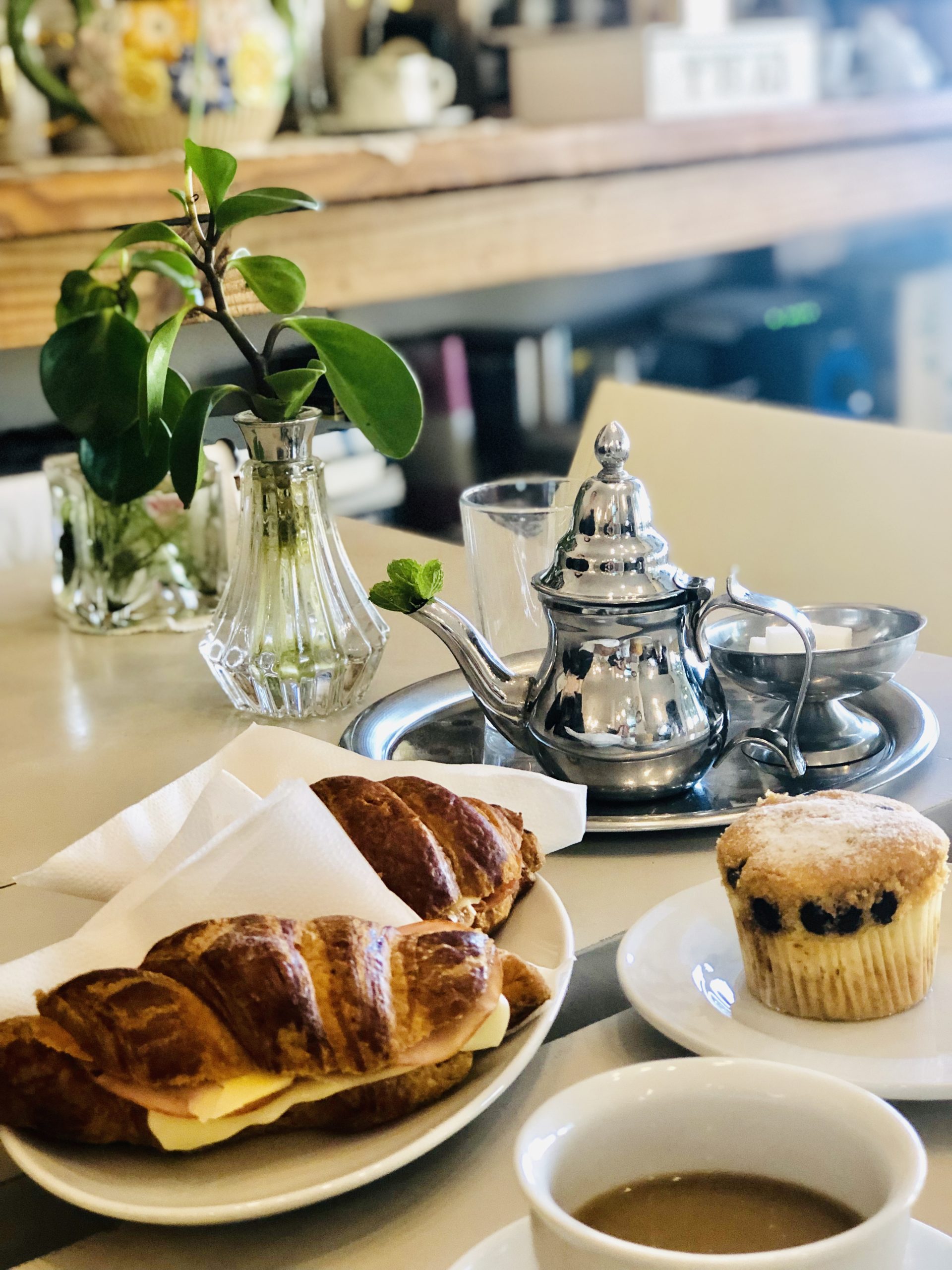
The scent is so strong, almost as if the force of a magnet has transformed into an aroma of particles that travel through time and space until they reach your nose. You feel them from a distance, and you almost decide within yourself that there’s no point in trying to postpone that moment. Like when you know perfectly well that something is both wrong and inevitable, and therefore, you should give in right away and see what happens. They bring it in elegant and hot inlaid silver trays, served together with a refined teapot with a seductive and climbing shape and tiny glasses that look like shots… with the only difference that you can’t touch them yet and that you can’t swallow them in a single sip.
It is up to the head of the family to approach the round table in the living room and pick up the teapot for what will be a solemn moment. It is up to him, in practice, to take care of the people in the room, who have the same dignity as the descendants of royal houses or the gurus of the Far East. Like a novice chef, the act of pouring requires meticulous concentration and precision. You can’t make mistakes; you can’t lower your arm too much or raise it with the risk of knocking everything over. You need to be at the right height, around 40cm, to enjoy the view of the gold-colored waterfall hitting the center of the colored glasses, leaving a soft, tickling foam. The noise is one that envelops you while the water continues to rise impetuously towards the edge. And when it stops, it doesn’t do it softly. But rampant, frothy, and unique.
Nothing is flat in Morocco, not even the foam of the mint tea that is served in its sumptuous welcoming ceremony for new arrivals. It is a dense foam full of meaning because it is unconventional and is not left to chance.
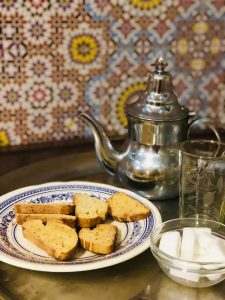
Atay Naa Naa, this is the name of the Moroccan tea ceremony, which in this country is practiced every day by families and also as a symbol of welcoming new arrivals. It represents the most refined expression of Moroccan hospitality, almost on par with China. On the other hand, the tea that is used as the basis for the composition of the sweetened mint drink is Chinese green tea due to its freshness and immense thirst-quenching and draining qualities.
But it wouldn’t be a particular tea if, in addition to the fragrant leaves dissolved freely in infusion in boiling water, a specific fresh Moroccan mint called Naa Naa, which is sold in plastic sticks in all the markets of the Medinas, was not added.
The silence that envelops the ritual of mint tea is rare and precious in a country that has made organized chaos its distinctive feature among tourists from all over the world. You come to Morocco to let yourself be transported by the chaos, the noises, the anarchic movements, the rampant and climbing colors on the walls, the labyrinthine architecture, and also its flavors.
The sweet taste is dense, almost insolent. To remind us to let go of our glossy perfections (and perceptions) and embrace the roaring anarchy of a passion-red land.
And yet… at tea time, everything suddenly becomes muffled, sacred. When the infusion of tea and boiling water is ready, the head of the family tastes and sweetens the tea directly, adding fresh Moroccan mint with a pungent aroma. You can already feel the ‘errouh,’ ‘the soul’ of the tea’ in Arabic, or the best part of the infusion, now free from the leaves to eliminate the bitterness. After a few more minutes, the tea is finally ready to be poured. From above, like all mighty souls, without the possibility of error, as only kings should be.
When you taste it, you think it’s too sweet. You have to think so: sugar in Morocco is still served in lumps, some even larger than 3-4 cm. In fact, the first few times I took it bitter, who doesn’t even put the sweetener in the coffee? Well, this recalcitrant rebellion linked to one’s habits won’t last long: the tea is good, too sweet, but it speaks the language of
the country you are visiting. And together with candied biscuits, dried fruit, and honey, it becomes a declaration of love.
My Moroccan tea, in the last few days spent in Marrakech before returning to Europe, was even more sugary than before.
Bread and Numbers (Michy)
Morocco is a country full of smells and tastes. Walking through the streets of Marrakech, you can’t help but notice the scent of homemade bread, and you struggle to understand where it comes from because it’s all around you (more so than Vodafone).
It’s called ‘khobz,’ and it’s a circle-shaped bread, slightly tall and fluffy, plain or with sesame seeds on top. It is made with durum wheat or even wholemeal flour and is served somewhat leavened. I’m a bread lover, and this one really tastes unique! I ate it in large quantities with chicken tajine, vegetables, and couscous… at times, I even dipped it in coconut milk. 😀 The problem was only one: the prices!
In Morocco, everything has a price: your comfort, your space, your language. It is not a country for the faint of heart. And so, even to buy bread, I often had to bargain! FOR THE BREAD! Well yes! Because being a tourist means HIGH MONETARY VALUE (bling bling… or fluss as they say here, even if I don’t know how to spell it) and LOW PERSONAL VALUE. Am I demanding? Absolutely, yes!
You are a number, at least for all those who live in the Medinas, who pull at your jacket to ask for alms and make you pay €4 for a coffee (it happened with AN ITALIAN woman who ran a place in Jemaâ El Fna, the main square of Marrakech… an Italian, for Diana!). You are a number for the worst taxi drivers in history, unpleasant and even a little arrogant, who, as soon as they notice something more significant than a fanny pack, assume that you are on a business trip and have a boatload of money to extract as many scams as possible!
But there is a remedy to all this, which the inhabitants of Morocco love the same: BARGAINING! Bargaining in Morocco is MANDATORY: You bargain for everything, everywhere, and in any language or word that allows you to understand each other. Sometimes, it is negotiated at hotels, which have loose policies on how to treat guests.
In short, ONLY THE BRAVES! Those who are tough resist in Morocco, and those who are weak succumb (and go home clean).
Spices and Argan Oil (Michy)
I am an inquisitive person, and for this reason, I try everything literally when I go around both for vacation (but when mail???) and for work. I love walking the streets in search of the most ambushed places, the less touristy ones, where you often eat better and are welcomed like a king.
I’m referring to what I call ‘the worst bars in Caracas,’ i.e., dive bars, bars that you wouldn’t give them two cents, bars that ooze fried oil, and grandma’s hands. Those places are my favorite! And in Morocco, there are many, especially in the Medinas.
As a lover of spices, one day, the owner of a dive bar in Caracas of Essaouira surprised me with his kindness by offering me a strange red porridge. It is a particular Moroccan food, a typical red sauce, a nectar of goodness and well-being for heart and breath (think it contains Vitamin E, vitamin C, iron, manganese, copper, vitamin B6, and vitamin K). Originally from North Africa, ‘Harissa’ is a thick-textured hot sauce that mainly contains chili peppers, red bell peppers, garlic, salt, and olive oil. The owner tells me that throughout North Africa, there are numerous variations of harissa depending on the region (or even the family), as some recipes include herbs and spices that are not present in the original recipe.
I loved the harissa, and I also loved the one who brought it to me because without my asking him, he made me discover something new! The flavor is really pungent, rich in nuances, and even a little acidic… and it drives me crazy (and blows my nose).
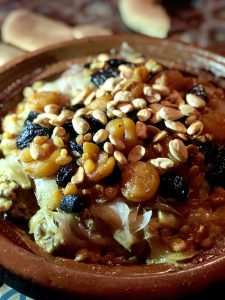
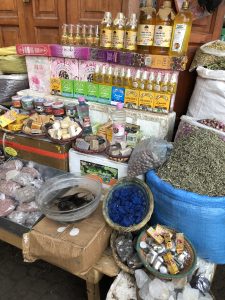
After all, among the typical Moroccan foods, there are indeed sauces and spices! Wandering the streets of Marrakech, in fact, you can find all the spices that have made Morocco famous. Common ones include cinnamon, cumin, turmeric, ginger, paprika, coriander, saffron, mace, cloves, fennel, anise, nutmeg, cayenne pepper, fenugreek, cumin, black pepper, and sesame seeds. Suffice it to say that as many as 27 (!!!) spices are combined for the famous Moroccan spice blend ‘ras el hanout.’
This is why the spice department in Moroccan kitchens, which I was able to visit thanks to some invitations to lunch and dinner, is the richest in COLORS. It is worth visiting Marrakech, Essaouira (if you don’t know it, absolutely one of the cities to see in Morocco) and the Medinas just for this!