Once upon a time in Morocco, we embarked on a journey that transformed our perception of exploration.
Morocco, a land of stark contradictions, beckoned us to traverse its arid deserts and bustling cities. The road less traveled led us to the heart of the unknown, where we encountered discomfort and uncertainty alongside warm hospitality and smiles. With every step, we discovered a paradoxical landscape where ancient traditions coexist with modern aspirations and where geographical borders blurred into shared living spaces. Our story is one of challenge and acceptance, of rejection and embrace, painting a vivid portrait of travelers forever changed by Morocco’s enigmatic allure.
One More Thing: The articles are interconnected through shared themes and the experiences of Mel and Michy. Each introduction provides a glimpse into a specific aspect of their journey in Morocco, with their perspectives interweaving to create a holistic narrative of exploration, emotion, and transformation.
Shared Spaces (Mel)
Shokran. Thank you. I get out of the taxi, a little annoyed. Despite my constant presence on the job, I am a somewhat reserved person when it comes to talking to people. I’m sociable, but I don’t reveal everything about myself, almost as if I want to protect some gray areas that I like to illuminate when I decide.
My trip to Marrakech was accompanied by a truly beastly heat, one of those that I didn’t remember on my skin after almost three years of living in the strangely temperate climate of the Canary Islands. Still, the sensation is delightful. I feel free to wear just one layer to separate my nakedness from that of the external environment, and this sensation gives me lightness. As for the rest, alas, I cannot say the same. How dare all these people touch me, pull me by the shirt, take my hand?
Morocco – I will find out shortly – is like this: you are never really left alone. You are not free to move or speak when suddenly you are surrounded by a common and organized action of children with disarming faces who sell you loose handkerchiefs or colored lighters, by women with veils and hands full of henna photo books, from transporters with carts ready to mount your suitcases and take you to the nearest hotel, from mopeds that whiz by 1 millimeter away from your nose, slamming you against the wall and from cars that move in directions that are incomprehensible to you but they obviously work.
And then the smog… which perpetually welcomes those who decide to visit Morocco wherever they go, especially mixed with the prevailing heat of July, the scent of freshly baked bread, and the hint of spicy chicken.I move towards the house, trying to dodge everything like in a Fortnite session. After saying NO to about ten people who asked me which hotel I was staying in to sell me everything I needed (or thought I wanted), I finally arrived at the door of the house where waiting for me together with the owner is a small group of children who sings to the rhythm of Arabic rap and strange but funny movements. As soon as they see me, they stop and come closer, talking about the peculiar chants, at least until I give them 1 dirham each (10 cents) and also a smile of gratitude.
The house owner is very kind. He lets me in by opening the door like a true gentleman and makes me sit on a typical Moroccan sofa that surrounds all sides of the living room, as is customary here.

I’m tired and would like to rest, but it’s not the time, and I notice it immediately. In fact, the entire family was waiting for me: two small children with crafty eyes, the wife with the elegant and brightly colored chador, and the eldest son. And a round and not very high table, set with all sorts of goodies: almond and amaretto biscuits, gelatinous candies, sesame seed chakra, cinnamon cakes, and dried fruit, kab el ghazal (“gazelle ankles”), golden makeout with almonds and honey, glazed briouats, and the typical baked cake m’hanncha or m’hancha, which means “snake” in Arabic due to its distinct rolled shape. I have never seen a buffet so harmoniously presented in composition, colors, and the general inviting delicacy!
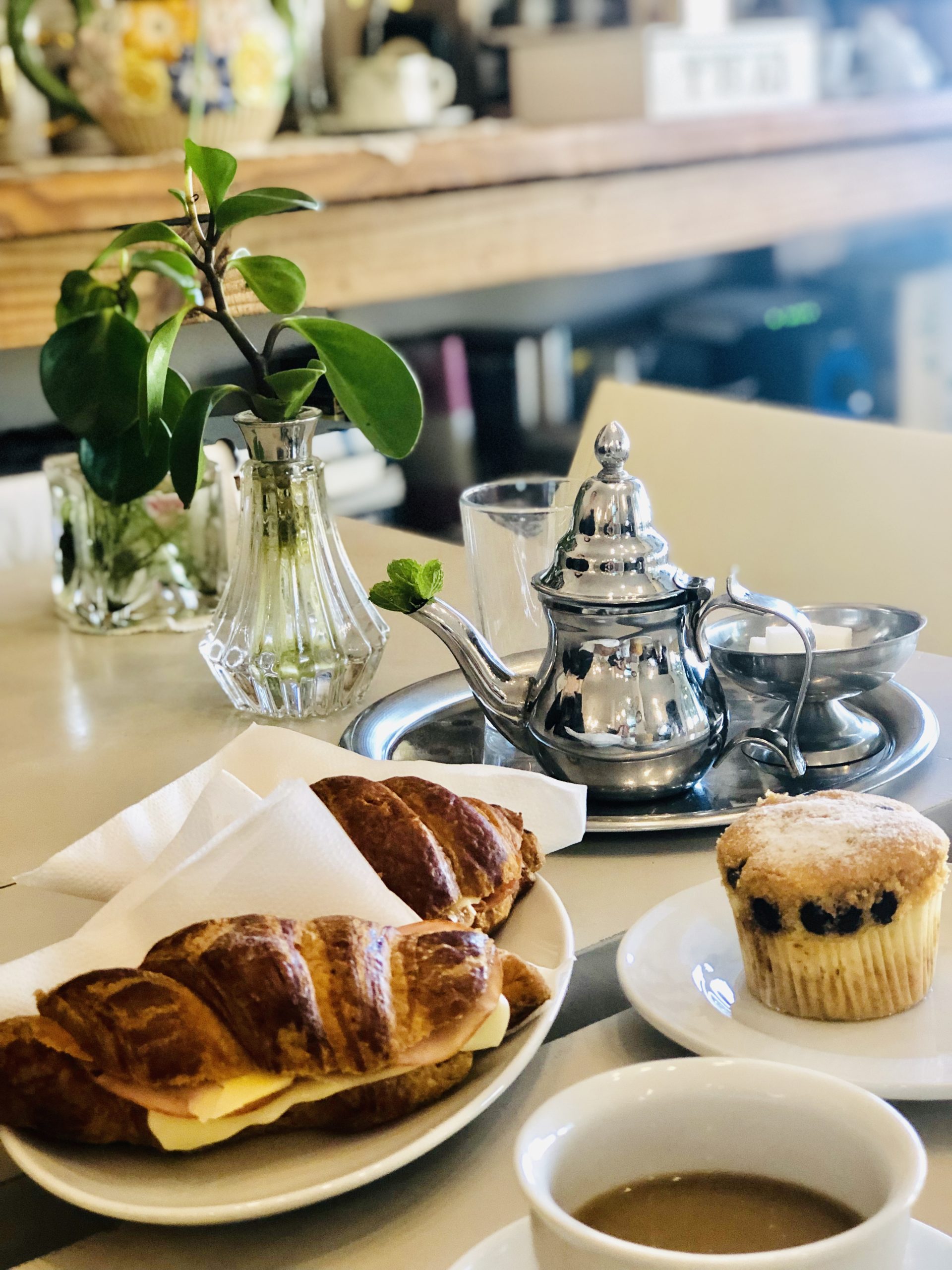
While I am still fascinated by the banquet they have prepared for my arrival, I realize that we are all solemnly awaiting the head of the family. In Morocco, contrary to what we are used to in Italy, it is up to the head of the family to serve a drink that symbolizes welcome and hospitality: Moroccan mint tea. And here he is, in the presence of his entire family, arriving with a shining silver tray to begin the ceremony…
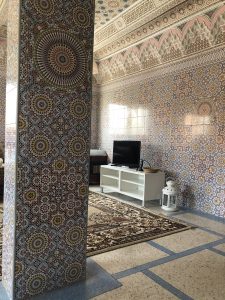
My room is upstairs. When I enter, I am struck in the eyes but also in the soul by the myriad of colors and streams of geometric and labyrinthine shapes. They are the walls of the room, with colored ceramic tiles, but also the floors that I tread with reverence, taking off my shoes. They are the embroidery of the pillows and blankets. They are the fiery red carpets. And it is the zellige that makes the Turkish bath (typical of the original Moroccan houses) an unexpected place of art.
‘What’s ours is yours. In Morocco, you will soon discover, we love one thing more than anything else: sharing.’ Hamza, the eldest son, greets me from the door with a Bslama goodbye, closing the inlaid wooden door behind him and leaving me alone.
But on the other hand, judging by the hospitality of this wonderful family I just met, ‘alone’ is a term that simply does not exist for those who decide to visit Marrakech!
Smog and Chaos (Michy)
My trip to Morocco was supposed to last three months, and I stayed just over one. But going back, I would probably stay for a maximum of 10 days. Don’t get me wrong: it is a WONDERFUL country, rich in history, with bright colors that characterize every single city (Casablanca is white, in fact, while Marrakech was designed in red… in fact, it is the most passionate! And there is also the glorious city blue of Morocco Chefchauen) and with fresh, uncontaminated and nutrient-rich flavors and smells. Yet, as I said, it should be taken in soft bites and chewed well, just as it should be done with its bread.
In Marrakech, for example, I couldn’t breathe; the smell of smog was so strong. Scooters, canary yellow and red taxis, Euro -20 cars, rickety buses… the color they screamed was only one: grey! Some diseases came out of the exhaust pipe, promptly fought by the government with only one low environmental impact bus a day (nothing but alternating license plates!).
In practice, as well as learning about smog in general, I met Mr. Smog himself, who greeted me with a perfect Italian accent!
That’s why, covered by a gray blanket, you are unable to settle in the chaos that reigns on the paved roads but also in the Medinas with the cobblestones … chaos of car horns, preposterous directions, four heads without helmets on the same moped, and approaching beggars kissing your arms and hands (it happened to me with a 5-year-old girl, perhaps the only woman to have put me in difficulty!).
Bargains (Mel)
Okay, I admit it, I think I have a problem with taxi drivers. It is as if, before granting them the patent, they had made selections for the most obnoxious and arrogant ones. And I’m using euphemisms instead of other, more precise words.
Bargaining starts when you look around. Like a hound dog, the taxi driver knows by the movements of your head that you need him and that you could potentially be a chicken to be plucked (and chickens are especially loved here). You don’t have time to move your eyes for more than a second before you find yourself surrounded by four or five taxi drivers looking for an exclusive ride. I’m waiting for you to decide, but not passively. In fact, if you are already talking to a colleague, it is very likely that others will arrive and take you away, the pace of the first arrival who is forced to leave with nothing in hand.
And when natural selection seems to have ended, with the victory of the most impertinent, here comes the so desperately awaited moment: price negotiation.
A premise: In Morocco, there are generally two types of taxis. The ‘normal’ taxi and the ‘deluxe’ taxi, which I nicknamed this because of the prices that aren’t even on an ordinary evening in Porto Cervo. The normal taxi is sand-colored (or even really covered up) and typically has a cost per ride (if there are two of you, you still pay the value of a single ride) of 7-8 dirhams, depending on the city where you are. In Euros, it costs around 70, 80 cents, so very low indeed.
“To the Majorelle Gardens, about 2 km. How much do you want?’.
‘It’s 500 dirhams.’
€5? For a ride that isn’t even worth 1?
Okay, don’t panic. I am in Morocco, the home of bargaining par excellence. And so, we have to negotiate.
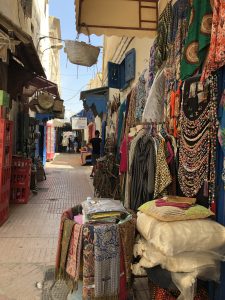
On the other hand, in Morocco, if you are a tourist, you will have to learn to negotiate for anything, even for the bread sold in closed stalls (a sort of mini food but without access, like a bar counter). If bread costs 1 dirham, they will ask you 3. If a cup of tea costs 2 €, they will ask you 4. Even in Jemaâ El Fna, the famous central square of Marrakech, an Italian (Italian!!!) lady had the courage to ask me €4 for an espresso that typically costs 0.70 cents. In short, negotiators’ lives are challenging.
The only way to survive, therefore, is to become more challenging than them. We are not tourists; we are travelers who have been living here for some time; we know the prices, and we know where you could screw us; we know where to go and when to go. And so we win. End of the story.
Contrasts (Michy)
I don’t like what I saw buried under the blanket of Instagrammed hotels, royal palaces, and botanical gardens from the Arabian Nights: the contrast between Luxury and Poverty is truly obscene.
Morocco, I only discover by setting foot there, is a monarchy. Everywhere, in fact, the insignia of King Muhammad VI welcomes passers-by and subjects in stations, offices, main public places, and even in some houses of devotees.
Yet, criticism rains down from all sides for a government that fails to make a country so touristy, so loved, and so potentially rich, free from street poverty.
Even though Morocco’s GDP has doubled since 2000, I also understood one thing: Muhammad VI is very worried… about building an imperial villa in every city rather than collecting garbage and beggars from every street corner. Mohamed Tozy, political scientist and director of the École de Gouvernance et d’Économie in Rabat, the university that prepares the future Moroccan elite, is also very critical, as he reports to Repubblica.it: ‘Let’s say that the reforms coincide with his kingdom, but it is as if the monarch were a prisoner of his role: conservative because his survival depends on it, and reformer out of political necessity. In Morocco, the monarchy adapts to society but does not transform it.
In fact, the King is not yet able to transform not so much the country’s bank account, which enjoys excellent health, as society is still tied to the Third World mentality.
Bslama (Michy)
After just over a month, I left Morocco to return to lands more congenial to me. But I’m sure it won’t be goodbye, but rather goodbye! However, I miss the landscapes, the expanses of infinite desert, the sweetest and most welcoming souls, the mint tea and almond and honey biscuits, and all those gems kept in the imperial cities and modern buildings like those of Agadir.
And I miss Morocco’s blue city, Chefchaouen, as blue is my favorite color. In short, I miss the most beautiful things Morocco can offer: small, sweet, and sugary moments (like tea) that give endorphins to traveling souls like me!
Bslama, Morocco! Despite of all this, see you soon!